







.jpg)


_1955.png)


The Soviet Flip
the
soviet flip
➤
➤
02 Palestine
Part Two · Palestine
Before "Free Palestine"
To understand the Soviet flip, we must first understand the reality it acted upon: a local conflict, a war, a refugee crisis, and the competing interests of the Arab states.
scroll down
132–135 CE
The province was known as Judea. Rome later renamed it.
Before “Palestine” There Was Judea
The name Palestine has ancient roots, but it did not originally describe the entire land. In the Hebrew Bible, Pleshet was the name of the coastal territory inhabited by the Philistines, stretching roughly from Jaffa south toward Rafah. Pleshet was the place; the Philistines were the ancient people who lived there.
Over time, the name entered Greek as Palaistine. Rome later adopted the Latin form Palaestina and expanded its meaning far beyond the original Philistine coastal region. Until then, the Roman province had officially been called Judaea - a name connected to the Jewish people and the ancient Kingdom of Judah. After Rome crushed the Bar Kokhba Revolt, it replaced the name Judaea with Syria Palaestina. A name that had originated with a limited coastal territory was now officially applied to the entire province.
It was not the name of an ancient Palestinian state or a modern Palestinian nation. It was the history of a geographical name:
Philistines → Pleshet/Philistia → Greek Palaistine → Roman Palaestina → Palestine
This traces the development of the name, not a direct ethnic line from the ancient Philistines to modern Palestinians.
A rare stone seal bearing an ancient Hebrew inscription from the First Temple period
First Temple period
Photo: Emil Aladjem / Israel Antiquities Authority
“House of David” inscription on a victory stele
Iron Age II, 9th century BCE
Credit: The Israel Museum, Jerusalem
Coins from the Bar Kokhba Revolt
132-136 CE
Source: Wikipedia
1900 - 1948
Neither a Vacuum nor a Fully Formed Identity
Who Were the Arabs of Palestine Before Palestinian Nationalism?
At the beginning of the twentieth century, many of the region’s Arab inhabitants did not yet identify primarily as a distinct Palestinian people.
The Landscape of Arab Identities in Palestine
1900 - 1948
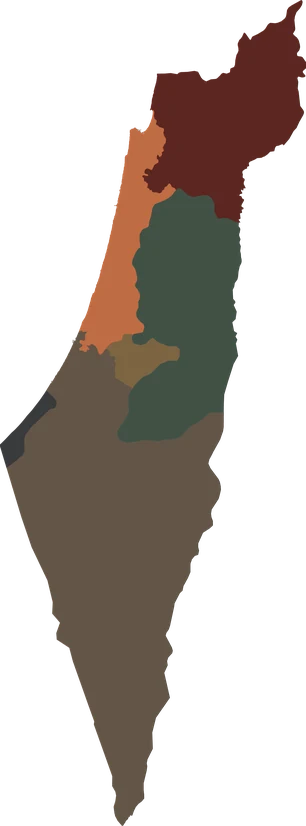
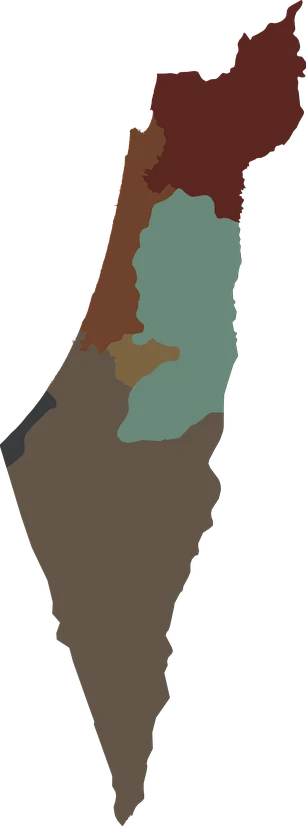
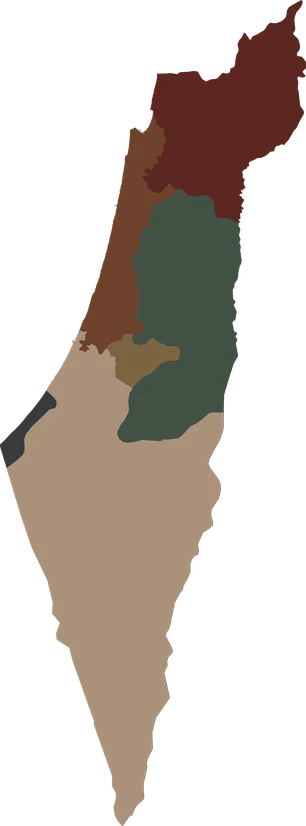
Northern Palestine - Greater Syria / Lebanon
In the Galilee, Acre, Nazareth, and Safed, local identity was closely tied to the Syrian-Lebanese region and to a broader Arab-Syrian identity.
Central Palestine - Local Urban Identity
In Jaffa, Lydda, Ramla, and the surrounding lowlands, local urban identity was strong alongside a broader Arab identity.
Jerusalem and Its Surroundings - Religious and Jerusalemite Identity
A historically rooted Islamic and Jerusalemite identity, alongside local and Ottoman loyalties.
Judea and Samaria - Local and Tribal Identity
In Nablus, Hebron, Ramallah, and the surrounding villages, identity was shaped by family and clan ties, local loyalties, and a broader Arab identity.
Gaza - Rural and Local Identity
A historically rooted Islamic and Jerusalemite identity, alongside local and Ottoman loyalties.
The Negev - Bedouin Tribal and Nomadic Identity
The main tribal groups were the Tarabin, Tiyaha, ‘Azazma, Jabarat, Hanajra, Sa‘idin, and Ahaywat.
Did Some of the Region’s Arabs Have Jewish Roots?
In 1918, David Ben-Gurion and Yitzhak Ben-Zvi argued that some of the Arab fellahin may have descended from Jewish and Samaritan farmers who remained in the land and later converted to Christianity or Islam.
Fellahin women crushing olives as part of the olive oil production process, Palestine, early 20th century.
Source: Library of Congress, Matson Photograph Collection
The Arab population was seen as part of Greater Syria.
Among Arabs, Palestine was often regarded as part of “Southern Syria.”
At the 1919 Damascus Congress, also known as the Syrian General Congress, Arab delegates opposed separating Palestine from Syria and regarded it as part of “Southern Syria.”
“Palestine must not be separated from the Syrian homeland.”
The Syrian General Congress, Damascus, 1919.
“We regard Palestine as nothing more than a part of Arab Syria.”
Aref al-Dajani, President of the Jerusalem Muslim-Christian Association, Jerusalem, 1919.
“There is no such country as Palestine; ‘Palestine’ is a term invented by the Zionists.”
Awni Bey Abd al-Hadi, Secretary-General of the Arab Higher Committee, testifying before the Peel Commission in 1937.
Palestine as Part of the Syrian Region, 1903
Map of the region, 1903
Source: DaWalda / Wikimedia Commons / CC BY-SA 4.0
Palestine as “Southern Syria”
The Syrian National Congress, 1920
Source: Syrian National Congress, 1920 / Public Domain
Faisal ibn Hussein, a Hashemite Arab leader who championed the vision of a united Arab Syria, Damascus, 1919.
Before the Establishment of Israel
Among Jews, “Palestine” Meant the Land of Israel
The Palestine-Eretz Israel national soccer team: Jewish players wearing the name “Palestine”.
The Mandatory Palestine Football Association was admitted to FIFA in 1929. In practice, the national team of the 1930s was organized by the Jewish football association, and its official matches were played by Jewish players.
Emblem of the Mandatory Palestine National Soccer Team, 1934-1940
Source: Global Sports Archive / Wikipedia
The Palestine–Eretz Israel National Soccer Team, 1931
Source: Israel Football Association / Wikimedia Commons / Public Domain
The Palestine-Eretz Israel National Team with the Greek National Team, 1938
Source: Israel Football Association / Wikimedia Commons / Public Domain
The Palestine-Eretz Israel National Team, 1940
Source: Israel Football Association / Wikimedia Commons / Public Domain
Zionist Posters from the Pre-State Period:
1912
Palestine Exhibition and Bazaar at the Bezalel School
Digital Source: Palestine Poster Project Archives (PPPA)
1919
Jews Fight for Palestine
Source: Hoover Institution / Stanford Digital Collections / No Known Restrictions
1922
Exhibition of Handicrafts from Palestine
Digital Source: Palestine Poster Project Archives (PPPA)
1929
Come and See Palestine
Digital Source: Palestine Poster Project Archives (PPPA)
1926
Palestine and the Near East
Digital Source: Palestine Poster Project Archives (PPPA)
1930
Help Build Eretz Israel-Palestine
Digital Source: Palestine Poster Project Archives (PPPA)
Hitler Fell. The Hatred Lived On.
The Mufti: A Bridge Between Nazism and the War Against Israel
Haj Amin al-Husseini was not merely the Grand Mufti of Jerusalem. He became a central political and religious figure in the Arab leadership of Mandatory Palestine and consistently opposed the establishment of a Jewish national home.
During World War II, he allied himself with Hitler in Berlin. After Nazi Germany fell, the antisemitic ideology did not disappear - it returned to the local arena.
The struggle against the State of Israel did not begin in a vacuum. It also drew on figures, ideas, and incitement that had already been connected to Nazism.
Hitler and Haj Amin al-Husseini, 1941
Source: Bundesarchiv, Bild 146-1987-004-09A / Heinrich Hoffmann / CC BY-SA 3.0 DE
Adapted by The Soviet Flip
Amin al-Husseini, 1929
Source: American Colony (Jerusalem), Photo Department; derivative work by Jbarta / Wikimedia Commons / Public Domain
Hitler receives Haj Amin al-Husseini, the Grand Mufti of Jerusalem, in Germany in 1941.
Source: Bundesarchiv Filmarchiv
The Mass Murder of Jews
Violence Against Jews Before the State of Israel
Violence against Jews did not begin in 1948. It predated the establishment of the state. Long before Israel was founded, Jewish communities in the country were repeatedly attacked in organized waves of violence - in Jerusalem, Jaffa, Hebron, Safed, and other towns and settlements.
The target was not an “Israeli occupation,” which did not yet exist, but Jewish immigration, Jewish settlement, and the idea of establishing a national home for the Jewish people.
Before the establishment of the State of Israel, thousands of Jews were killed in the Land of Israel as a result of Arab violence, including riots, terrorist attacks, and other assaults.
1517
Attacks on the Jews of Hebron and Safed During the Ottoman Conquest
1799
The Jews of Safed Were Persecuted During Napoleon’s Campaign
1834
The Safed Pogrom and the Attacks on the Jews of Hebron
1838
During a Druze revolt against Egyptian rule, the Jewish Quarter of Safed was attacked once again.
1660
The Destruction of Safed and Tiberias
1720
The Ruin of Rabbi Judah the Pious in Jerusalem
1873
Aharon Hershler, a resident of Mishkenot Sha’ananim, was murdered in 1873 while attempting to defend his family’s home. Today, he is officially recognized as the first casualty of Israel’s wars and hostilities.
The Abraham Avinu Synagogue in ruins after being vandalized by Arabs in Hebron.
Nebi Musa celebrations in Jerusalem. The crowd later went on to carry out the riots.
The Pogrom at the Torat Chaim Yeshiva Study Hall
Male and Female Fighters in Arab Armed Bands
1921
The Jaffa Riots and Their Spread to the Jewish Settlements
47 Jews were killed, and 146 were injured.
1920
Nebi Musa Riots, Jerusalem
5 Jews were killed, and more than 200 were injured.
1929
Hebron, Safed, and Jerusalem
133 Jews were killed, and 339 were injured.
1936 - 1939
The Great Arab Revolt
415 Jews were killed, and hundreds more were injured.
The Rejection of Partition Leads to War
The War Did Not Begin with the “Nakba” - It Began with Rejection
On November 29, 1947, the United Nations General Assembly adopted Resolution 181, proposing the partition of Mandatory Palestine into two states: one Jewish and one Arab.
The Jewish leadership accepted the plan despite its difficult borders, the lack of territorial continuity, and the fact that much of the proposed state’s territory consisted of the Negev. The Arab leadership rejected the plan, and that rejection quickly turned into war.
After Israel declared independence on May 14, 1948, the armies of neighboring Arab states also entered the war. Israel survived, but at the cost of 6,373 lives.
The number of deaths among the local Arab population remains uncertain. Benny Morris, professor of history at Ben-Gurion University, estimates that between 6,000 and 12,000 were killed. In addition, the armies of the Arab states lost approximately 2,000 men, almost all of them soldiers.
Resolution 181: The Official Document
The United Nations resolution that established a partition plan with an economic union between the two states.
Source: United Nations General Assembly Secretariat / Wikimedia Commons / Public Domain
Archival Footage: Palestine 1948 Arab-Israeli War, 1948
The footage is identified by the source as Public Domain and was licensed through Buyout Footage Historic Stock Footage Archive.
1948 Is Not a Single Story
Not Every Departure Was an Expulsion
The claim that all Arabs were expelled in 1948 does not reflect the complexity of the historical record. In July 1948, an order was issued prohibiting the destruction, burning, or demolition of Arab towns and villages except during active combat. Even in the midst of a brutal war, there was no single overarching order to “expel everyone and destroy everything.”
The reality on the ground was far more complicated. Expulsions did occur, and many people fled because of fear and the pressures of war. But there were also orders intended to limit destruction, as well as cases in which Jewish institutions urged Arab residents to remain.
One example is the leaflet issued by the Haifa Workers’ Council on April 28, 1948, which directly appealed to Haifa’s Arab residents to stay in the city and return to work. The documents therefore do not support the claim that every Arab departure resulted from one uniform policy of expulsion.
The reality was far more complex - and that is precisely why the historical truth matters.
Public Appeal Issued by the Haifa Workers’ Council of the Histadrut, Haifa, 1948
Copyright: This work is held by the Lavon Institute - Labor Movement Archive. Educational use is permitted under fair-use provisions. In Copyright - Educational Use Permitted
Arabs Return to Haifa and Seek Jewish Protection, 1948
HaBoker, April 25, 1948 / National Library of Israel
Municipal Notice Prohibiting Unauthorized Entry, Looting, and Damage to Property, May 1948
There were also official efforts to control the chaos and prevent damage to property after residents had left.Credit: Tel Aviv - Yafo Municipal Archives, Tel Aviv-Yafo Municipality. From the “Public Noticeboard” project.
1948 - 1949
Following the Rejection of the Partition Plan and the Establishment of the State of Israel
Where Did the Arab Population Go?
Approximately 700,000 - 750,000 Arabs left the areas affected by the war.
Approximately 156,000 - 158,000 remained within Israel.
The movement was largely geographic:
The north - to Lebanon and Syria
The center - to the West Bank, Gaza, and nearby cities of refuge
Jerusalem - to the West Bank and East Jerusalem
The south and the Negev - to Gaza, Sinai, and Jordan
Snapshot of the Departure of the Region’s Arab Population, June 1946 - May 1948
To Syria:
75,000 - 85,000
Lebanon
To Lebanon:
100,000 - 110,000
To Iraq:
4,000
To the West Bank:
280,000
To Gaza:
100,000 - 110,000
To Jordan:
70,000
Jordan
To Egypt:
100,000 - 110,000
Egypt
1949 - 1950
Before “Palestinian Liberation,” the Refugee Category Took Shape
The Refugees Become an International System
After 1948, Arabs from the region who fled or were expelled became part of an internationally recognized category: “refugees.” In 1949, UNRWA was established to provide direct relief and work programs for them. At the same time, the United Nations Conciliation Commission addressed questions of return, resettlement, rehabilitation, and compensation.
At this stage, the language was not yet that of a “national liberation movement.” The central terms were refugees, relief, return, compensation, and resettlement.
Palestinian Refugees in Lebanon, 1948
Credit: UN Photo / UN7498126
Palestinian refugees boarding boats, 1949
Credit: Hrant Nakashian / UN Archives / Wikimedia Commons
1950
Arab States Take Control of the Refugees
From Arab Refugees to a “Palestinian People”
After the 1948 war, no Arab Palestinian state was established. Instead, the territory and population were divided among other powers: Jordan annexed the West Bank and East Jerusalem, Egypt administered Gaza without formally annexing it, and the refugees came under the framework of UNRWA.
The result was that Palestinian identity existed, but still lacked a sovereign institution capable of governing or representing it independently. It remained caught between Jordan, Egypt, the Arab League, and the United Nations.
1950
Map of the West Bank Under Jordanian Rule
UNRWA Sign
UNRWA Begins Operations
The refugee issue moves into an international humanitarian framework.
Jordan Annexes the West Bank
East Jerusalem and the West Bank are incorporated into Jordan.
Nasser
From Nazi Antisemitism to State - Sponsored Anti-Zionism
A Nazi Legacy in Anti-Zionist Disguise
Gamal Abdel Nasser was a young Egyptian officer when he fought against the newly established State of Israel in the 1948 war. He was among the Egyptian forces surrounded in the Faluja Pocket. He emerged from that experience with more than the memory of defeat. He drew a political conclusion:
The old Egypt had failed, and a new Arab power had to be built.
Gamal Abdel Nasser with Egyptian soldiers in Faluja during the 1948 war.
First published in the Egyptian newspaper Dar al-Hilal.
Gamal Abdel Nasser in Belgrade, 1962.
Photo: Stevan Kragujević.
Nasser, Naguib, and Suleiman at the beginning of the Free Officers’ rule in Egypt, 1952.
Source: Bibliotheca Alexandrina / Nasser Digital Archive
1952
The Free Officers Revolution
On July 23, 1952, Gamal Abdel Nasser and the Free Officers overthrew Egypt’s monarchy and removed King Farouk from power.
July
1953
Egypt Becomes a Republic
The Revolutionary Command Council, led by the Free Officers, dissolved and banned the country’s political parties. The monarchy was formally abolished, and Egypt was declared a republic - shifting power from the royal palace to the military.
June
1954
Nasser Becomes Egypt’s De Facto Ruler
Two years after the revolution, Nasser pushed Muhammad Naguib out of power, became prime minister, and consolidated his position at the head of the new regime.
April
Nasser greets the crowds in Cairo after becoming Prime Minister of Egypt, 1954.
1955
February
The Shift from “Refugees” to a “Front”
Gaza Erupts - and Redemption Becomes an Instrument.
In 1955, Gaza became a focal point of conflict. Protests broke out against plans to resettle refugees outside the Gaza Strip, while tensions along the border continued to rise. Following Israel’s raid on Gaza in February 1955, Nasser changed course. Gaza’s Arab population was no longer treated solely as a refugee community under Egyptian administration. It was gradually mobilized as an operational force through the fedayeen.
1955 marked the moment when Gaza ceased to function only as a refugee camp and became a political and military laboratory.
The document shows that, at this stage, there was still no independent Palestinian body directing the conflict.
Gaza was under Egyptian control, and the confrontation unfolded through the Egyptian military, the Egyptian administration, the Gaza border, and infiltrators.
Operation Black Arrow: The Gaza Incident
(Night of February 28–March 1, 1955) Operation File
Attribution: IDF Spokesperson’s Unit
Gamal Abdel Nasser, 1955
Source: picture-alliance / United Archives
September
Nasser Gains Both a Front in Gaza and Soviet Backing.
The Arms Deal: Nasser Opens the Door to Moscow
In the same year that Gaza erupted, Nasser signed the Czechoslovak-Soviet arms deal. It was more than a weapons agreement. It opened a channel of dependence involving arms, training, maintenance, advisers, and expanding military and intelligence ties. From this point onward, the Soviet Union gained a foothold in Egypt, and the Nasser - Moscow alliance began to take shape.
The escalation in Gaza and the Soviet arms deal unfolded within the same period.
HaBoker - “Egypt Will Uphold the Arms Agreement with Czechoslovakia,” October 3, 1955
Source: National Library of Israel
1956
February
Nazi Propaganda Enters Arab Propaganda
In February 1956, the Egyptian government hired Johann von Leers, a former Nazi propagandist and antisemitic ideologue, as a political and propaganda adviser in the Information Department. By August 1956, he was reported to be working in Nasser’s Ministry of National Guidance, in a unit described as the “Israel Propaganda Department.”
Officials in West Germany believed that Haj Amin al-Husseini, the Grand Mufti of Jerusalem, had helped arrange von Leers’s appointment in Nasser’s Ministry of National Guidance.
Johann von Leers: pictured on the left as a young man in Nazi Germany, and on the right around 1958, after his move to Cairo.
Credit: Cover of Johann von Leers (1902–1965) by Martin Finkenberger, Vandenhoeck & Ruprecht / Brill Deutschland GmbH, 2023. Cover images: Bundesarchiv / Political Archive of the German Foreign Office.
A 1958 CIA document in which he is identified as “Professor Johannes (Omar Amin) von Leers,” based in Maadi, Cairo.
Source: CIA Freedom of Information Act Electronic Reading Room, file: LEERS, JOHANNES VON, declassified document, 1958.
July
Suez Transforms a Local Conflict into a Global Symbol
Nasser Becomes an Anti-Imperialist Hero
The Suez Crisis transformed Nasser into a symbol across the Arab world. Britain, France, and Israel were portrayed as colonial powers, while Nasser was presented as the leader of Arab liberation.
The Soviet Union recognized the political opportunity and strengthened Nasser through both diplomacy and propaganda. From this point onward, Soviet and Nasserist political language increasingly began to overlap.
Nasser is greeted enthusiastically by supporters in Cairo following his announcement of the nationalization of the Suez Canal Company, August 1, 1956.
Credit: Nasser Cheered by Supporters in 1956 / Wikimedia Commons. Creator unknown. Description source: CIA publication, 2007. Public Domain in Egypt.
Egyptian postage stamp commemorating the nationalization of the Suez Canal, July 26, 1956.
Credit: Nationalization of Suez Canal 26-7-1956 / Wikimedia Commons. Creator unknown. Public Domain in Egypt.
Aerial view of Port Said during the Suez Crisis, with smoke rising from damaged oil tanks near the Suez Canal.
Credit: Imperial War Museums / Wikimedia Commons, Port Said from the Air. Official Fleet Air Arm photograph, Port Said, November 5, 1956. Public Domain—UK Government work.
October
Operation Kadesh
On October 29, 1956, Israel launched Operation Kadesh, with Britain and France joining the conflict. The Suez Crisis transformed Nasser into an anti-imperialist hero across the Arab world.
After Suez, the Political Language Began to Shift:
The West = Imperialism
Israel = A Western or Colonial Outpost
The Arabs = Peoples Struggling for Liberation
The Soviet Union = Recognizes the Moment and Strengthens Nasser Politically and Through Propaganda
1957
Neither Citizenship nor Statehood - An Identity in the Making
Fatah: An Identity Born in Exile
Fatah did not emerge from an existing Palestinian state, but from a young Arab generation living in exile. Yasser Arafat was born in Cairo to a family with roots in Gaza and Jerusalem. Khalil al-Wazir, known as Abu Jihad, was born in Ramla, became a refugee in 1948, and grew up in Gaza.
They did not hold passports issued by a Palestinian state, come from a sovereign Palestinian country, or represent a people with independent national institutions. They emerged from diaspora, displacement, and the memory of a lost homeland.
In 1957, in Kuwait, members of this generation began forming the nucleus of Fatah - a movement that sought to transform shared origins, refugeehood, and political memory into a modern national identity capable of speaking in its own name. After 1948, they took the experience of displacement, family memory, and the language of “national liberation” and turned them into a new political project:
A modern Palestinian identity.
The Muslim Brotherhood
Johann von Leers
Khalil al-Wazir joined the Muslim Brotherhood in Gaza in 1952 and served as secretary of its student branch. He later left the organization after its leadership refused to support his proposal for a more militant course of action against Israel.
The Mufti
In 1946, while still a student in Cairo, Yasser Arafat met Haj Amin al-Husseini. He later became active in a group affiliated with the Arab Higher Committee, which was headed by the Mufti.
Yasser Arafat
Khalil al-Wazir
Fatah
Palestinian National Liberation Movement
حركة التحرير الوطني الفلسطيني
Harakat al-Tahrir al-Watani al-Filastini
1958
Pan-Arabism from Above, “Palestinian Rights” from Abroad
Nasser at His Peak, Moscow Adopts the Language
In February 1958, Egypt and Syria united under Nasser to form the United Arab Republic - an attempt to bring the Arab world together as a single political bloc under his leadership. That same year, on May 15, 1958, at the conclusion of Nasser’s official visit to Moscow, the Soviet Union and the United Arab Republic issued a joint communiqué expressing support for the “legitimate rights of the Palestinian Arabs” and referring to their displacement from their homes.
Even before the PLO and Arafat entered the international arena, Moscow was beginning to frame the refugee issue through the language of rights and national liberation.
Joint Statement by the Governments of the Soviet Union and the United Arab Republic, 1958.
The section concerning the Palestinians appears around page 13 of the PDF, corresponding to page 11 of the original booklet.
Egyptian postage stamp from 1957 depicting the Gaza Strip under the slogan: “Gaza - Part of the Arab Nation.”
Credit: Palestine Poster Project Archives, Gaza Part of Arab Nation, Egyptian postage stamp, 1957.
Demonstrations in the suburbs of Damascus celebrating the union of Syria and Egypt and the establishment of the United Arab Republic, 1958.
Credit: Demonstrations in the Suburbs of Damascus in Honor of Syria’s Unification with Egypt, 1958 / Wikimedia Commons. Creator unknown. Source: Antika Syria / Facebook. Public Domain in Syria.
1959
The Newspaper That Turned Refugeehood into Political Language
Filastinuna: When Refugeehood Acquired a Political Language
Even before Fatah emerged, Arafat was already active in international student networks. In 1954, he joined a student delegation to Warsaw, and in 1955 the Palestinian student organization was admitted to the International Union of Students, a pro-Soviet organization based in Prague and operating within a broader socialist and anti-colonial environment. In 1959, Filastinuna - “Our Palestine” - appeared in Beirut. It was the publication through which the name Fatah began to emerge from the shadows. The newspaper developed within networks Moscow understood well: student movements, youth conferences, anti-colonial activism, and the language of “national liberation.”
Through Filastinuna, the refugee experience of 1948 began to shift from a humanitarian story of camps and relief into a political narrative of movement, peoplehood, return, and liberation.
Newspaper clippings from Filastinuna / فلسطيننا - a Palestinian periodical published in Beirut between 1959 and 1964.
Credit: Institute for Palestine Studies / Palestinian Social History Archive, قصاصات من مجلة فلسطيننا - excerpts from issues of Filastinuna, Beirut, 1959–1964.
Foreign delegations at the World Festival of Youth and Students in Warsaw, 1955 - an international forum for students, youth movements, and anti-colonial discourse within the Soviet bloc.
Credit: Zbyszko Siemaszko / Narodowe Archiwum Cyfrowe, V Światowy Festiwal Młodzieży i Studentów w Warszawie, Warsaw, 1955, Ref. 51-372-100.
1960 - 1963
The Fracture in Pan-Arabism
The Language Shifts: From Pan-Arabism to Palestinian Consciousness
Between 1960 and 1963, cracks began to appear in Nasser’s vision of pan-Arab unity. The union with Syria, intended to prove that the Arab world could be united under a single state, collapsed in September 1961. Its failure weakened the image of Nasser as the leader capable of bringing all Arabs together.
As pan-Arabism lost strength in practice, “Palestine” began to emerge as a more powerful political symbol. It was no longer framed only through refugees, borders, and wars between Israel and the Arab states, but through a new language of Arab socialism, anti-imperialism, national liberation, and armed struggle.
At the same time, Israel was developing an almost opposite vision of its future: a national water system, the Dimona nuclear project, expanding security ties, and a state building for the long term. Its identity was shaped not only by the memory of 1948, but by labor, infrastructure, and an increasingly established independence.
In UNRWA’s 1961–1962 report, Palestinians were still described mainly as displaced refugees dependent on aid. But refugee status was already evolving from a temporary humanitarian condition into a political identity built around return, compensation, and national claims.
UNRWA, Annual Report of the Commissioner-General of the United Nations Relief and Works Agency for Palestine Refugees in the Near East, 1 July 1961–30 June 1962, United Nations General Assembly, A/5214, 1962.
Rashidieh Refugee Camp, Lebanon, 1963. Newly constructed concrete buildings to which Palestinian refugees were relocated on land allocated by the Lebanese government.
Credit: UNRWA Photo / Wikimedia Commons, Rashidieh Refugee Camp in 1963. Photographer unknown, 1963. Marked as Public Domain on Wikimedia Commons.
1964
Palestine Takes Institutional Form - Israel Builds Its Future
The Palestine Liberation Organization Is Born
In 1964, the Arab League initiated the creation of the Palestine Liberation Organization. The first Palestinian National Council convened in Jerusalem at the end of May, and the PLO was formally established on June 2, 1964. Ahmad Shukeiri became its first chairman.
That same year, Israel completed the National Water Carrier. For Israel, it was a project of survival: water, agriculture, settlement, and the country’s future. For the Arab world, it represented something more threatening - Israel was not disappearing; it was becoming firmly established.
In this way, 1964 brought together two parallel developments:
On one side, the creation of an official Palestinian institution.
On the other, a regional struggle over the infrastructure essential to Israel’s existence.
In 1964, “Palestine” ceased to be merely an Arab slogan and began to take shape as an organized political framework.
PLO Emblem 1964
Ahmad Shukeiri and Abdel-Karim al-Alami alongside other founders of the PLO, outside the organization’s headquarters in the Sheikh Jarrah neighborhood of Jerusalem, 1964-1965.
Credit: “Abdel-Karim with the PLO Founders in Front of its Headquarters, Jerusalem, 1964-65,” The Abdel-Karim al-Alami Collection, The Palestinian Museum Digital Archive.
Arab League Summit in Cairo, January 1964. The gathering illustrates the broader Arab framework within which the PLO was established later that year.
Credit: Arab League Summit, 1964 / Bibliotheca Alexandrina / Wikimedia Commons / Public Domain
1965 - 1966
From Symbolic Action to Regional Escalation
The PLO and Israel’s National Water Carrier
In 1965, Fatah made a decisive transition - from publications, exile politics, and underground cells to military communiqués and organized acts of sabotage.
Al-‘Asifa, “the Storm,” presented Fatah as a movement unwilling to wait for Nasser, the Arab League, or the Arab armies. Militarily, its early operations were limited. Symbolically, however, the shift was significant: the refugee was recast as a fighter, and return became a slogan of armed struggle.
By 1966, these operations were contributing to wider regional escalation. Israel retaliated, Jordan came under growing pressure, Syria encouraged a more confrontational approach, and the divide between Ahmad Shukeiri’s official PLO and Fatah’s underground movement continued to widen.
“Palestine” was no longer merely an Arab slogan or an institution on paper. It was beginning to take shape as an armed myth capable of destabilizing the entire region.
Right: An IDF command vehicle that struck a landmine near Arad in 1966.
Right — Photo: IDF Spokesperson’s Unit / Wikimedia Commons / CC BY-SA 3.0
Left: An IDF command vehicle damaged by a landmine on the patrol road in the southern Hebron Hills, November 12, 1966.
Left — Photo: IDF Spokesperson’s Unit / Wikimedia Commons / CC BY-SA 3.0
David Ben-Gurion and a group of engineers inspecting a large section of pipe for Israel’s National Water Carrier.
Photo: Mekorot Historical Archive / Israel State Archives, Levi Eshkol Commemoration Project.
Sections of the National Water Carrier’s main pipeline being prepared along “Line 108” for assembly and connection. The image has been digitally edited for design purposes.
Credit: Central Zionist Archives, NCHS Collection, Reference NCHS\493924.
1967
The Arab Defeat That Became a Palestinian Opportunity
When Nasser Fell, Palestine Rose
An inaccurate Soviet report claiming that Israeli forces were preparing to attack Syria set off a chain reaction. During the same period, Israel’s nuclear program is believed to have become fully operational, giving the country the capacity to produce nuclear weapons for the first time.
In 1967, Nasser sent Egyptian forces into the Sinai, demanded the withdrawal of the United Nations Emergency Force, and closed the Straits of Tiran - a move Israel regarded as a red line.
Within six days, the Arab world lost more than territory. It lost a myth. Nasser, pan-Arabism, and the promise that Arab armies would liberate Palestine were shattered. Nasser announced his resignation and later withdrew it under public pressure, but the rupture had already occurred. The defeat opened the way for a new political force. Ahmad Shukeiri’s PLO weakened, while Fatah presented itself as the movement prepared to take the struggle into Palestinian hands. Israel was also transformed, now controlling Judea and Samaria, East Jerusalem, Gaza, the Sinai Peninsula, and the Golan Heights.
1967 was not merely a war. It was a moment of transition. Before it, Palestine had largely existed as a symbol within the broader Arab narrative. Afterward, it increasingly became an independent political story - one that could be promoted, armed, translated, and presented to the world as a national liberation struggle.
Caricature of Gamal Abdel Nasser Following the Six-Day War
Credit: Ranan Lurie / Wikimedia Commons License: CC BY-SA 3.0 Attribution: Oil and acrylic painting by Ranan Lurie. First published in LIFE magazine in 1968.
Right: Mass demonstrations in Egypt on June 9–10, 1967, following Gamal Abdel Nasser’s announcement of his resignation after Egypt’s defeat in the Six-Day War.
Source: Al-Ahram Weekly / Wikimedia Commons License: Public Domain
Left: David Rubinger’s iconic photograph of Israeli paratroopers beside the Western Wall in Jerusalem, taken shortly after Israeli forces captured the Old City during the Six-Day War on June 7, 1967.
Credit: David Rubinger / Government Press Office / Wikimedia Commons File name: Paratroopers at the Western Wall.jpg
Did the Soviets Push the Crisis Toward Escalation Over the Dimona Reactor?
According to later accounts, Soviet reconnaissance aircraft - identified as MiG-25 “Foxbats” - flew over Israel’s nuclear facility at Dimona in May 1967 as part of an intelligence - gathering effort focused on Israel’s nuclear program. Years later, a spokesperson for the Russian Air Force referred to “unique” reconnaissance flights over Israeli territory in 1967. Some researchers interpreted this statement as indirect confirmation of the claim.
1968
The Armed Myth Takes Shape
Fatah Takes Over the PLO
In 1968, the rupture of 1967 began to take the form of a new narrative.
After the Arab states failed, Fatah and the fedayeen offered a different answer: no longer waiting for Nasser, the Arab armies, or the old PLO, but pursuing independent Palestinian action. The moment that cemented this shift was the Battle of Karameh in March 1968. Militarily, Israel struck fedayeen bases in Jordan. But in the Arab world, the battle was portrayed as the moment when Palestinian fighters stood their ground against the IDF rather than fleeing. Fatah used the battle to build a new myth: the refugee was no longer only a victim - he was now a fighter.
“Palestine” was no longer merely a memory or an Arab promise. It had become a revolution with its own language, flag, organization, and communiqués.
That same year, the revised Palestinian National Charter adopted much sharper language: national struggle, Palestinian identity, and armed struggle as a strategy rather than merely a temporary means. This was the moment when the PLO began to change from within - from an official Arab institution created under the sponsorship of the Arab League into a framework increasingly taken over by the guerrilla organizations, led by Fatah.
Excerpt from We Are the Palestinian People (Newsreel #65), an activist documentary produced by Newsreel that portrays the rise of the Palestinian liberation movement after 1967 through footage of refugee camps, fedayeen training, and interviews with Palestinian activists. The film is listed in the Alexander Street catalog as a 1968 production.
We Are the Palestinian People (Newsreel #65), Third World Newsreel / Newsreel, 1968. Courtesy of Alexander Street / ProQuest.
1969
From Armed Struggle to Diplomatic Warfare
The Moment “Palestine” Took Political Form
By 1969, the process had acquired a clear political structure. Arafat and Fatah no longer remained outside the PLO - they took control of it. At the fifth session of the Palestinian National Council in Cairo in February 1969, Arafat was elected chairman of the PLO Executive Committee.
This marked the real transition. The PLO of Ahmad Shukeirian organization created from above by Arab regimes - gave way to a new PLO, one that spoke in the name of the “Palestinian revolution” and presented itself as the representative of the Palestinian people.
At the same time, the language of the international arena also began to change. In 1967, the United Nations still spoke primarily of the “refugee problem.” But in December 1969, General Assembly Resolution 2535 introduced a fundamentally different formulation: “the inalienable rights of the people of Palestine.”
This was not a minor semantic change. It was a shift in the entire framework.
United Nations General Assembly Hall, New York. The UN and Palestine: General Assembly Resolutions.
UN General Assembly Hall, New York City.
Photo: Patrick Gruban / Wikimedia Commons, via PalQuest -Interactive Encyclopedia of the Palestine Question.
***This exposes one of the false claims Arafat himself promoted: he presented himself as having been born in Jerusalem, when in fact he was born in Cairo, Egypt.
Interview with Yasser Arafat, The Morning Record, February 6, 1969
The New York Times, “Fatah Wins Control of Palestine Group,” February 5, 1969.
And this is where the next chapter begins:
Who helped transform this language into a powerful instrument of international propaganda?
The Soviet Union.
For source corrections, archival material, licensing questions, or additional information related to this research, please contact: info@thesovietflip.com
© 2026 The Soviet Flip. All rights reserved. All content, research, text, design, and visual materials are protected by copyright unless otherwise credited.