For source corrections, archival material, licensing questions, or additional information related to this research, please contact: info@thesovietflip.com

© 2026 The Soviet Flip. All rights reserved. All content, research, text, design, and visual materials are protected by copyright unless otherwise credited.

How the KGB and the Soviet system transformed the Palestinian cause into a diplomatic, propaganda, and international instrument - moving it from the battlefield into the global consciousness.

When Language Becomes a Weapon

Part Three · The New Narrative

What Was the KGB?

1954 After Stalin’s Death and the Breakdown of Relations with Israel

The Creation of the KGB: A New Security Apparatus for a New Cold War. In 1954, one year after Stalin’s death, the Kremlin established the KGB in an effort to bring the Soviet security services back under firm party control.

Born out of the crisis of authority that followed Stalin’s death, the KGB became the Soviet Union’s central instrument in its struggle against the United States. Within that broader confrontation, Israel and Zionism were increasingly cast as part of the Western front.

The new agency was created to confront two threats at once.

At Home

Population control

Suppression of dissent

Suspicion of “Zionist” activity״

Abroad

Intelligence Operations

Propaganda and Influence

Against the United States and the West

Active Measures

Active Measures were the Soviet Union’s system of political and psychological influence. This was not conventional public diplomacy or openly attributed propaganda, but a coordinated network of disinformation, forged materials, media amplification, front organizations, and agents of influence. The goal was not merely to persuade, but to reshape the framework through which events were understood - to lead audiences, governments, and the media to interpret reality using the language and assumptions the KGB sought to embed.

Creating doubt, anger, guilt, and public pressure was often enough to turn a narrative into an instrument of state power.

The Method

Engineering Perception

Agents of Influence

Message Saturation Through Repetition

Document Forgery

Front Organizations

Disinformation

State-Funded Media

Political Antisemitism

Demonstrations and Conferences

The Method

Active Measures

סרטון ארכיוני

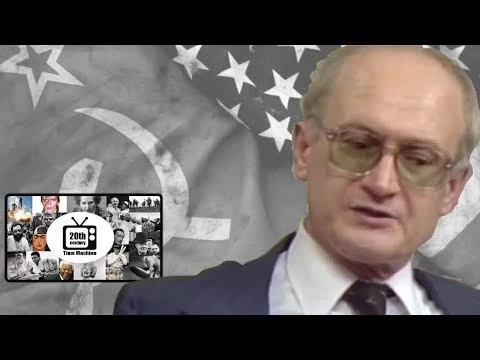
Yuri Bezmenov: Propaganda as a Strategic Weapon

Yuri Bezmenov was a former Soviet journalist who worked for the Novosti Press Agency before defecting to the West. During the 1980s, he described the Soviet system of influence as “ideological subversion” - a long-term process designed not only to change political opinions, but to reshape the way a society understands reality itself.

According to Bezmenov, the Soviet struggle against the West and across its various spheres of influence relied on more than espionage and military power. It operated through propaganda, media, education, political movements, and the constant repetition of carefully chosen language

until that language became accepted as public “truth.”

“The KGB did not merely gather intelligence - it manufactured reality.”

KGB defector Yuri Bezmenov explains how the Soviet intelligence service sought to influence and manipulate public opinion in the United States.

Yuri Bezmenov, interviewed by G. Edward Griffin, Soviet Subversion of the Free Press: A Conversation with Yuri Bezmenov, American Media, Westlake Village, California, ©1984. Later released by Reality Zone under the title Deception Was My Job.

Click to Play

Tactic 1: Changing the Language

Redefining the Enemy

From “Israel” and “Zionism” to “Imperialism”

The first step was not simply to attack Israel, but to replace the language through which the world understood it.
Instead of speaking about a war between states, a territorial conflict, or a Jewish state fighting for its survival, Soviet rhetoric linked Israel and Zionism to far more charged terms: imperialism, colonialism, racism, and oppression.

Once the language changes, the entire frame changes with it.

Israel is no longer presented as a small country caught in a regional conflict, but as a symbol of the Western bloc. Not as a people restoring their sovereignty after centuries of persecution, but as an outpost of foreign power. Not as one side of a complex historical conflict, but as part of a global struggle between the “oppressed” and the “oppressors.”

The goal was not merely to make the case against Israel. It was to establish a new political vocabulary - one in which the word “Zionism” itself already sounded like an accusation.

Tactic 2: Reframing

From Refugees to “National Liberation”

The goal is not merely to change the language, but to change the entire frame.

The story is no longer presented as “a refugee question created by the 1948 war.”

It becomes the story of an oppressed indigenous people struggling against colonialism.

Once the conflict is framed as a war of “national liberation,” Israel is automatically cast as the oppressor.

Tactic 3: Infrastructure

A Narrative Needs Infrastructure

An idea alone is not a political force.

For a narrative to become one, it needs more than words: newspapers, training, agents, weapons, funding, diplomatic ties, conferences, and propaganda channels. Here, the KGB operates as the architect and coordinator of a broader network.

Tactic 4: Proxy Warfare

A War Fought Without Soviet Uniforms

Don’t fight directly -support, arm, and let others do the fighting.

Back armed organizations, train operatives, and supply weapons.

Build ties with Arab regimes while others apply the pressure on the ground.

Israel confronts terrorism, propaganda, and political pressure - while Moscow maintains an official distance.

Tactic 5: Infiltrating the Movement

Building Connections Within the Organizations

Tactic 6: The Repetition Machine

Press, Posters, and Recycled Messaging

A narrative needs a machine to reproduce it

The same language is repeated until it begins to sound natural: “occupation,” “apartheid,” “imperialism,” “racism,” “liberation,” “aggression.”

It is a system designed to create an entirely new political vocabulary.

Tactic 7: Rebranding

Not “Jews” “Zionists”

Tactic 8: Legitimization

From the Streets to the United Nations

“American Imperialism”

A Soviet poster depicting the United States as a predatory bird guarding a sack of money, surrounded by Israeli soldiers, 1971.

Ominous, Palestine Poster Project Archives.

Courtesy of The Palestine Poster Project Archives / PPPA.

“Zionism Is Racism” (1976)

The poster portrays Zionism as an oppressive, violent, and racist force that subjugates Arabs and Palestinians.

Ominous, Palestine Poster Project Archives.

Courtesy of The Palestine Poster Project Archives / PPPA.

Israel

Transcript

“Zionism learned a great deal from the Nazis. They claimed to be a superior race, while the Zionists claim to be the chosen people, above all other nations.
Anyone who is not Jewish, they call a ‘goy.’ Do you know what ‘goy’ means? Someone who is not human.
The similarity is astonishing. That is why I call Zionism the neo-Nazism of our modern world.”

Soviet archival footage of Yasser Arafat speaking about “Zionism,” 1982.

Central Studio for Documentary Films, recipient of the Order of Lenin and the Order of the Red Banner, Moscow, 1982.

Propaganda Book - Beware: Zionism! (1970)

The framing did not remain confined to posters - it spread into books, pamphlets, and political education.

Credit: Yury Ivanov, Beware: Zionism!, Library of the Memorial Society / Jewish Museum and Tolerance Center. Google Arts & Culture notes that the book was published in 1970 as part of a state-sponsored anti-Zionist campaign launched after the Six-Day War.

The Mitrokhin Archive and KGB files released after the collapse of the Soviet Union contain codenames assigned to Palestinian leaders and organizations.

The use of codenames - together with records of training, weapons, funding, and intelligence contacts - points to an operational relationship, not merely a diplomatic one.

Yasser Arafat

Aref

Mahmoud Abbas

Krotov

Fatah

Kabinet

Vasili Mitrokhin
Former KGB Archivist

Abu Iyad

Kochubey

Wadi Haddad

Nationalist

The Democratic Front

Shkola

Nayef Hawatmeh

Inzhener

Ahmad Jibril

Mayorov

The Popular Front

Khutor

The KGB

Click to Play

Gamal Abdel Nasser

“Abu Khaled”

Yasser Arafat

“Abu Ammar”

Nayef Hawatmeh

“Abu an-Nuf”

Ahmad al-Shukeiri

“Abu al-Nawf”

Wadi Haddad

“Abu Hani”

George Habash

“Al-Hakim”

Khalil al-Wazir

“Abu Jihad”

Ahmad Jibril

“Abu Jihad”

Mahmoud Abbas

“Abu Mazen”

“The KGB destroyed Arafat’s official birth records in Cairo and replaced them with fabricated documents claiming that he had been born in Jerusalem.” - Ion Mihai Pacepa

Ion Mihai Pacepa was one of the most senior intelligence officials in communist Romania and one of the highest-ranking defectors from the Soviet bloc to the West. Until his defection to the United States in 1978, he served as deputy chief of Romanian foreign intelligence and was a close adviser to Nicolae Ceaușescu.

After defecting, Pacepa exposed the espionage networks, corruption, and disinformation operations of communist regimes in his books. He became a prominent source on the methods used by Soviet intelligence and its allies during the Cold War.

A New Political Biography: A leader born in Cairo was recast as a figure with deep Palestinian roots in Jerusalem.

Propaganda Training:
According to the account, Arafat received training at the Soviet intelligence school in Balashikha, near Moscow.

Funding:

Ion Mihai Pacepa claimed that during the 1970s he personally transferred approximately $200,000 a month to Arafat.

Recruitment as a KGB Agent:
The KGB regarded Haddad as a key operational asset through whom it could influence PFLP activities beyond the Middle East.

Funding:

According to the Mitrokhin Archive, Haddad received covert funding from the KGB.

Weapons:

A 1975 KGB document records that Haddad received a shipment of weapons and ammunition from the Soviet intelligence service.

Doctoral Studies in Moscow:
Wrote an anti-Zionist dissertation portraying Zionism as a form of Nazism.

Recruitment as a KGB Agent:
Ideological and propaganda activity, political connections in Moscow, and access to Soviet circles.

Yasser Arafat

Aref

Mahmoud Abbas

Krotov

Wadi Haddad

Nationalist

PFLP Terrorist Organization

Popular Front for the Liberation of Palestine

PFLP-GC Terrorist Organization

Popular Front for the Liberation of Palestine - General Command

DFLP Terrorist Organization

Democratic Front for the Liberation of Palestine

DFLP Military Wing

National Resistance Brigades

Fatah

Palestinian National Liberation Movement

Palestinian Authority

Palestinian National Authority

PLO

Palestine Liberation Organization

Muhammad Oudeh

“Abu Daoud”

PLF

Palestine Liberation Front

According to biographer Said Aburish, in July 1968 Nasser invited Arafat to accompany the Egyptian delegation on an official visit to the Soviet Union. Arafat traveled on an Egyptian passport under the name “Mohsin Amin,” rather than appearing openly under his own identity.

Wadi Haddad - Terrorism as a Global Stage

Wadi Haddad headed the PFLP’s external operations. He worked with the KGB under the codename “Nationalist.” The KGB viewed him as a valuable asset - someone through whom it could influence the PFLP’s operations without leaving Soviet fingerprints.

Wadi Haddad understood the power of televised terrorism.

A hijacking was not merely an armed operation - it was a broadcast.

Terrorism was not designed only to inflict harm. It was designed to send a message.

Black September

The Massacre of the Israeli Olympic Team in Munich

On September 5, 1972, members of Black September broke into the Israeli team’s quarters at the Munich Olympics, killing two members of the delegation and taking nine others hostage. After negotiations and a failed rescue attempt, all nine hostages were murdered. In total, 11 Israeli athletes and coaches were killed.

According to archival records from communist Czechoslovakia, Abu Daoud played a central role in planning the Munich attack. He selected the attackers, arranged the logistics, supplied the weapons, surveyed the Olympic Village, and helped one of the operatives gain access before the operation.

Terrorism Becomes a Global Stage

Excerpt from Maariv, published on September 7, 1972.

The article, published in the aftermath of the massacre of the Israeli athletes at the Munich Olympics, describes how hope and tension gave way to grief and outrage across Israel. Source: Maariv, September 7, 1972. Historical Jewish Press Collection, National Library of Israel.

Excerpt from an article published in Maariv on March 19, 1976.

Source: Maariv, March 19, 1976. Historical Jewish Press Collection, National Library of Israel, in partnership with Tel Aviv University.

According to U.S. documents, Libyan embassies served as conduits for Soviet weapons transported through diplomatic mail. In the case of the 1972 Munich attack, it was alleged that the perpetrators received their weapons in Germany through the same network.

Under Muammar Gaddafi, Libya became one of the main Arab destinations for weapons supplied by the Soviet bloc. Gaddafi purchased vast quantities of military equipment from the Soviet Union and Eastern Europe - far beyond Libya’s own defense needs - and turned the country into a hub for the transit, training, and financing of Palestinian organizations.

The Murder of the Israeli Athletes at the 1972 Munich Olympics

Excerpt from a dramatized film about the operation to capture those behind the attack, produced by Reshet in 2006.

“They Will Not Succeed in Strangling the Freedom of the Arab People!” (1959)

A Soviet anti-Western and anti-Israeli poster portraying the Arab world as a victim of political and economic pressure from the United States and Israel, while framing the Arab struggle as a movement of liberation.

Source: The Palestine Poster Project Archives / Plakat Posters, USSR.

Visitors at an exhibition held at the House of Friendship with Foreign Peoples on the International Day of Solidarity with the Palestinian People, Moscow, November 29, 1978.

Source: RGAKFD - Russian State Archive of Film and Photo Documents. Reference: 0-393442 b/w. Storage Unit No. 393442.

Posters at a Moscow rally proclaiming, “Zionism is a close relative of fascism and racism.”
Participants in a solidarity rally with the Palestinian people carry anti-Zionist political posters on a Moscow street, March 1988.

Photo: V. Gordeyev. Source: RGAKFD - Russian State Archive of Film and Photo Documents, Electronic Photo Catalogue. Archival reference: 0-394276 b/w. Storage Unit No. 394276.

Zionism

Imperialism

Racism

Nazism

The Dawson’s Field Hijackings, 1970

The blowing up of the planes, broadcast on Jordanian television in 1970.

The 1972 Lod Airport Massacre

On May 30, 1972, three members of the Japanese Red Army, acting in coordination with the Popular Front for the Liberation of Palestine, carried out an attack at Lod Airport - today known as Ben Gurion Airport.

26 people were killed and dozens more were wounded.

Don’t fight directly - support, arm, and let others do the fighting.

Ghassan Kanafani

A Palestinian writer, journalist, and leading ideologue, Kanafani was one of the most prominent voices of the Popular Front for the Liberation of Palestine. His role in the 1970 Dawson’s Field hijackings was not operational but political and propagandistic. He helped frame the event not simply as an act of terrorism, but as a carefully staged operation intended to turn the Palestinian cause into a globally broadcast spectacle.

Kanafani was assassinated in Beirut in 1972 in an operation attributed to Israel’s Mossad.

Vladimir Ilyich Lenin

Lenin’s portrait on the wall reflects the Popular Front’s ideological ties to Marxism-Leninism and to the revolutionary language of the Soviet bloc.

Press conference held by members of the Popular Front for the Liberation of Palestine following the Dawson’s Field hijackings in Jordan, September 15, 1970.

Source: Jordanian Archives / Wikimedia Commons. License: Public Domain.

The KGB trained Wadi Haddad.

Haddad ran the PFLP’s External Operations branch

the terrorist organization known as the Popular Front for the Liberation of Palestine.

The PFLP, in turn, used the Japanese Red Army to carry out its operations.

Soviet Agents’ Infiltration of Israel

KGB Agents Inside Israel

Shabtai Kalmanovich was a Soviet-born businessman and immigrant who gained access to political and business circles in Israel. In 1988, he was convicted of spying for the KGB. After his release, he returned to Russia and built an international business career. On November 2, 2009, he was shot dead in his car in Moscow - an attack Russian authorities believed was most likely a contract killing.

Kalmanovich was active in the Labor Party, worked in the Knesset, and was also involved in government communications. According to published reports and testimony, he had close ties to Golda Meir and other senior political figures.

The Shin Bet later recruited him as a double agent - but his true allegiance remained with the KGB.

After his release from prison in Israel, Kalmanovich built an extensive network of contacts across the Middle East, including senior Israeli and Arab figures - most notably Yasser Arafat, Muammar Gaddafi, and Bashar al-Assad.

The 1972 Lod Airport Massacre

Excerpt from archival footage by Kan 11.

Front page of Maariv, May 31, 1972.

Credit: Maariv, May 31, 1972, p. 1. From the Historical Jewish Press Collection, National Library of Israel.

Shabtai Kalmanovich alongside Ariel Sharon.

Photo: Shaul Golan | From a 2012 Uvda investigative report.

Shabtai Kalmanovich alongside Yigal Allon.

Photo: Gedalia Rozhanski | From a 2012 Uvda investigative report.

Shabtai Kalmanovich

Shabtai Kalmanovich served in the Soviet Red Army.

From a 2012 Uvda investigative report.

The KGB

Other Israeli Agents

An Israeli diplomat and Foreign Ministry official, he was convicted in 1956 of spying for the Soviet Union. According to published reports, he also gained access to Israeli intelligence circles and passed along sensitive information.

A military historian with close ties to Israel’s security establishment, he was arrested in 1961, convicted of spying for the Soviet Union, and ultimately sentenced to 15 years in prison.

A senior official at the Israel Institute for Biological Research in Ness Ziona, he was convicted of spying for the Soviet Union and sentenced to 20 years in prison. He is considered one of the most significant Soviet spies ever uncovered in Israel.

A reserve colonel and former senior defense official, he was convicted in 1993 of spying for the KGB and sentenced to 12 years in prison.

“Stop the Aggressors

Soviet Union, 1958. Source: The Palestine Poster Project Archives.

“Israeli Aggression Must End”

Soviet Union, 1967. Source: The Palestine Poster Project Archives.

“Tanks were once in fashion among the fascists - everyone remembers those cursed years. But in Tel Aviv, they seem to have forgotten how that aggression ended.”

Soviet Union, 1972. Source: The Palestine Poster Project Archives.

1958

1967

1972

“Israel’s aggressive and annexationist policies… and the condemnation of Israeli aggression.”

United Nations General Assembly, Official Records, 2400th Plenary Meeting, Document A/PV.2400, p. 10, para. 129, November 1975.

1975

Word

Repeat

Habit

Accepted Truth

Ze’ev Avni

Israel Beer

Marcus Klingberg

Shimon Levinson

The Trick: Rebranding Old Ideas in New Language

Instead of “Jews” “Zionists”

Instead of “Jewish conspiracy” “Zionist imperialism”

Instead of “antisemitism” “anti-colonial struggle”

This is how old ideas enter academic, journalistic, and diplomatic discourse - without appearing to be old-fashioned antisemitism.

“Zionism and Nazism: Two Sides of the Same Coin”

Soviet Union, 1980. Source: The Palestine Poster Project Archives.

“Similar Typography”

Soviet Union, 1970. Source: The Palestine Poster Project Archives.

"Free Palestine"

1948 - 1940

The Slogan’s Origins

Jewish and Zionist

1954 - Present

The New Framing

Palestinian Arab

The Palestine Poster Project Archives.

The Palestine Poster Project Archives.

Chaim Herzog’s address to the United Nations following the adoption of Resolution 3379 in 1975.

Excerpt from his speech.

Chaim Herzog, Israel’s representative to the United Nations, addresses the General Assembly in November 1975, following the adoption of Resolution 3379, which declared that “Zionism is a form of racism.”

Source: UN Photo

When Propaganda Becomes International Policy

At the United Nations, the message no longer looks like propaganda - it carries the authority of the “international community.”

Resolution 3379 (1975): “Zionism is a form of racism.”

A propaganda narrative becomes a diplomatic resolution.

1975 — “Zionism is racism”

Modern Palestinian identity was shaped within an antisemitic ideological framework. The Soviet Union and the broader anti-Western bloc gave that framework a language, political backing, and a global platform. Israel was cast as an outpost of Western imperialism, while the Palestinian struggle was recast as a movement of national liberation.

In this way, refugeehood became a political identity, and the conflict became an international narrative.

“History is not written. History is made.”

David Ben-Gurion

03 New Narrative

scroll down

the soviet flip

“Zionism is the Weapon of Imperialism!"

May Day parade, Moscow, USSR, 1972

Photo: Vladimir Sichov.

“On Palestinian land occupied by Israel, those fighting against aggression and for their people’s sacred right to have an independent state of their own are arrested and imprisoned.”

USSR, 1978

Soviet Union, 1978. Source: The Palestine Poster Project Archives.

Cover of Yevgeny Yevseyev’s 1971 Soviet book Fascism Under the Blue Star, which portrayed Zionism as a form of fascism as part of the USSR’s anti-Zionist propaganda campaign.

USSR, 1971

Fascism Under the Blue Star, Yevgeny Yevseyev, Moscow, 1971. Cover designer unknown. Image source: Russian Wikipedia; originally sourced from URSS.ru.

Zionism as a snake

USSR, 1979

Illustration by Vsevolod Ternavsky, 1979.

To be continued...

For source corrections, archival material, licensing questions, or additional information related to this research, please contact: info@thesovietflip.com

© 2026 The Soviet Flip. All rights reserved. All content, research, text, design, and visual materials are protected by copyright unless otherwise credited.

How the KGB and the Soviet system transformed the Palestinian cause into a diplomatic, propaganda, and international instrument - moving it from the battlefield into the global consciousness.

When Language Becomes a Weapon

Part Three · The New Narrative

What Was the KGB?

1954 After Stalin’s Death and the Breakdown of Relations with Israel

The Creation of the KGB: A New Security Apparatus for a New Cold War. In 1954, one year after Stalin’s death, the Kremlin established the KGB in an effort to bring the Soviet security services back under firm party control.

Born out of the crisis of authority that followed Stalin’s death, the KGB became the Soviet Union’s central instrument in its struggle against the United States. Within that broader confrontation, Israel and Zionism were increasingly cast as part of the Western front.

The new agency was created to confront two threats at once.

At Home

Population control

Suppression of dissent

Suspicion of “Zionist” activity״

Abroad

Intelligence Operations

Propaganda and Influence

Against the United States and the West

Active Measures

Active Measures were the Soviet Union’s system of political and psychological influence. This was not conventional public diplomacy or openly attributed propaganda, but a coordinated network of disinformation, forged materials, media amplification, front organizations, and agents of influence. The goal was not merely to persuade, but to reshape the framework through which events were understood - to lead audiences, governments, and the media to interpret reality using the language and assumptions the KGB sought to embed.

Creating doubt, anger, guilt, and public pressure was often enough to turn a narrative into an instrument of state power.

The Method

Engineering Perception

Agents of Influence

Message Saturation Through Repetition

Document Forgery

Front Organizations

Disinformation

State-Funded Media

Political Antisemitism

Demonstrations and Conferences

The Method

Active Measures

סרטון ארכיוני

Yuri Bezmenov: Propaganda as a Strategic Weapon

Yuri Bezmenov was a former Soviet journalist who worked for the Novosti Press Agency before defecting to the West. During the 1980s, he described the Soviet system of influence as “ideological subversion” - a long-term process designed not only to change political opinions, but to reshape the way a society understands reality itself.

According to Bezmenov, the Soviet struggle against the West and across its various spheres of influence relied on more than espionage and military power. It operated through propaganda, media, education, political movements, and the constant repetition of carefully chosen language

until that language became accepted as public “truth.”

“The KGB did not merely gather intelligence - it manufactured reality.”

KGB defector Yuri Bezmenov explains how the Soviet intelligence service sought to influence and manipulate public opinion in the United States.

Yuri Bezmenov, interviewed by G. Edward Griffin, Soviet Subversion of the Free Press: A Conversation with Yuri Bezmenov, American Media, Westlake Village, California, ©1984. Later released by Reality Zone under the title Deception Was My Job.

Click to Play

Tactic 1: Changing the Language

Redefining the Enemy

From “Israel” and “Zionism” to “Imperialism”

The first step was not simply to attack Israel, but to replace the language through which the world understood it.
Instead of speaking about a war between states, a territorial conflict, or a Jewish state fighting for its survival, Soviet rhetoric linked Israel and Zionism to far more charged terms: imperialism, colonialism, racism, and oppression.

Once the language changes, the entire frame changes with it.

Israel is no longer presented as a small country caught in a regional conflict, but as a symbol of the Western bloc. Not as a people restoring their sovereignty after centuries of persecution, but as an outpost of foreign power. Not as one side of a complex historical conflict, but as part of a global struggle between the “oppressed” and the “oppressors.”

The goal was not merely to make the case against Israel. It was to establish a new political vocabulary - one in which the word “Zionism” itself already sounded like an accusation.

Tactic 2: Reframing

From Refugees to “National Liberation”

The goal is not merely to change the language, but to change the entire frame.

The story is no longer presented as “a refugee question created by the 1948 war.”

It becomes the story of an oppressed indigenous people struggling against colonialism.

Once the conflict is framed as a war of “national liberation,” Israel is automatically cast as the oppressor.

Tactic 3: Infrastructure

A Narrative Needs Infrastructure

An idea alone is not a political force.

For a narrative to become one, it needs more than words: newspapers, training, agents, weapons, funding, diplomatic ties, conferences, and propaganda channels. Here, the KGB operates as the architect and coordinator of a broader network.

Tactic 4: Proxy Warfare

A War Fought Without Soviet Uniforms

Don’t fight directly -support, arm, and let others do the fighting.

Back armed organizations, train operatives, and supply weapons.

Build ties with Arab regimes while others apply the pressure on the ground.

Israel confronts terrorism, propaganda, and political pressure - while Moscow maintains an official distance.

Tactic 5: Infiltrating the Movement

Building Connections Within the Organizations

Tactic 6: The Repetition Machine

Press, Posters, and Recycled Messaging

A narrative needs a machine to reproduce it

The same language is repeated until it begins to sound natural: “occupation,” “apartheid,” “imperialism,” “racism,” “liberation,” “aggression.”

It is a system designed to create an entirely new political vocabulary.

Tactic 7: Rebranding

Not “Jews” → “Zionists”

Tactic 8: Legitimization

From the Streets to the United Nations

“American Imperialism

A Soviet poster depicting the United States as a predatory bird guarding a sack of money, surrounded by Israeli soldiers, 1971.

Ominous, Palestine Poster Project Archives.

Courtesy of The Palestine Poster Project Archives / PPPA.

“Zionism Is Racism” (1976)

The poster portrays Zionism as an oppressive, violent, and racist force that subjugates Arabs and Palestinians.

Ominous, Palestine Poster Project Archives.

Courtesy of The Palestine Poster Project Archives / PPPA.

Israel

Transcript

“Zionism learned a great deal from the Nazis. They claimed to be a superior race, while the Zionists claim to be the chosen people, above all other nations.
Anyone who is not Jewish, they call a ‘goy.’ Do you know what ‘goy’ means? Someone who is not human.
The similarity is astonishing. That is why I call Zionism the neo-Nazism of our modern world.”

Soviet archival footage of Yasser Arafat speaking about “Zionism,” 1982.

Central Studio for Documentary Films, recipient of the Order of Lenin and the Order of the Red Banner, Moscow, 1982.

Propaganda Book - Beware: Zionism! (1970)

The framing did not remain confined to posters - it spread into books, pamphlets, and political education.

Credit: Yury Ivanov, Beware: Zionism!, Library of the Memorial Society / Jewish Museum and Tolerance Center. Google Arts & Culture notes that the book was published in 1970 as part of a state-sponsored anti-Zionist campaign launched after the Six-Day War.

The Mitrokhin Archive and KGB files released after the collapse of the Soviet Union contain codenames assigned to Palestinian leaders and organizations.

The use of codenames - together with records of training, weapons, funding, and intelligence contacts - points to an operational relationship, not merely a diplomatic one.

Yasser Arafat

Aref

Mahmoud Abbas

Krotov

Fatah

Kabinet

Vasili Mitrokhin
Former KGB Archivist

Abu Iyad

Kochubey

Wadi Haddad

Nationalist

The Democratic Front

Shkola

Nayef Hawatmeh

Inzhener

Ahmad Jibril

Mayorov

The Popular Front

Khutor

The KGB

Click to Play

Gamal Abdel Nasser

“Abu Khaled”

Yasser Arafat

“Abu Ammar”

Nayef Hawatmeh

“Abu an-Nuf”

Ahmad al-Shukeiri

“Abu al-Nawf”

Wadi Haddad

“Abu Hani”

George Habash

“Al-Hakim”

Khalil al-Wazir

“Abu Jihad”

Ahmad Jibril

“Abu Jihad”

Mahmoud Abbas

“Abu Mazen”

“The KGB destroyed Arafat’s official birth records in Cairo and replaced them with fabricated documents claiming that he had been born in Jerusalem.” - Ion Mihai Pacepa

Ion Mihai Pacepa was one of the most senior intelligence officials in communist Romania and one of the highest-ranking defectors from the Soviet bloc to the West. Until his defection to the United States in 1978, he served as deputy chief of Romanian foreign intelligence and was a close adviser to Nicolae Ceaușescu.

After defecting, Pacepa exposed the espionage networks, corruption, and disinformation operations of communist regimes in his books. He became a prominent source on the methods used by Soviet intelligence and its allies during the Cold War.

A New Political Biography: A leader born in Cairo was recast as a figure with deep Palestinian roots in Jerusalem.

Propaganda Training:
According to the account, Arafat received training at the Soviet intelligence school in Balashikha, near Moscow.

Funding:

Ion Mihai Pacepa claimed that during the 1970s he personally transferred approximately $200,000 a month to Arafat.

Recruitment as a KGB Agent:
The KGB regarded Haddad as a key operational asset through whom it could influence PFLP activities beyond the Middle East.

Funding:

According to the Mitrokhin Archive, Haddad received covert funding from the KGB.

Weapons:

A 1975 KGB document records that Haddad received a shipment of weapons and ammunition from the Soviet intelligence service.

Doctoral Studies in Moscow:
Wrote an anti-Zionist dissertation portraying Zionism as a form of Nazism.

Recruitment as a KGB Agent:
Ideological and propaganda activity, political connections in Moscow, and access to Soviet circles.

Yasser Arafat

Aref

Mahmoud Abbas

Krotov

Wadi Haddad

Nationalist

PFLP Terrorist Organization

Popular Front for the Liberation of Palestine

PFLP-GC Terrorist Organization

Popular Front for the Liberation of Palestine - General Command

DFLP Terrorist Organization

Democratic Front for the Liberation of Palestine

DFLP Military Wing

National Resistance Brigades

Fatah

Palestinian National Liberation Movement

Palestinian Authority

Palestinian National Authority

PLO

Palestine Liberation Organization

Muhammad Oudeh

“Abu Daoud”

PLF

Palestine Liberation Front

According to biographer Said Aburish, in July 1968 Nasser invited Arafat to accompany the Egyptian delegation on an official visit to the Soviet Union. Arafat traveled on an Egyptian passport under the name “Mohsin Amin,” rather than appearing openly under his own identity.

Wadi Haddad - Terrorism as a Global Stage

Wadi Haddad headed the PFLP’s external operations. He worked with the KGB under the codename “Nationalist.” The KGB viewed him as a valuable asset - someone through whom it could influence the PFLP’s operations without leaving Soviet fingerprints.

Wadi Haddad understood the power of televised terrorism.

A hijacking was not merely an armed operation - it was a broadcast.

Terrorism was not designed only to inflict harm. It was designed to send a message.

Black September

The Massacre of the Israeli Olympic Team in Munich

On September 5, 1972, members of Black September broke into the Israeli team’s quarters at the Munich Olympics, killing two members of the delegation and taking nine others hostage. After negotiations and a failed rescue attempt, all nine hostages were murdered. In total, 11 Israeli athletes and coaches were killed.

According to archival records from communist Czechoslovakia, Abu Daoud played a central role in planning the Munich attack. He selected the attackers, arranged the logistics, supplied the weapons, surveyed the Olympic Village, and helped one of the operatives gain access before the operation.

Terrorism Becomes a Global Stage

Excerpt from Maariv, published on September 7, 1972.

The article, published in the aftermath of the massacre of the Israeli athletes at the Munich Olympics, describes how hope and tension gave way to grief and outrage across Israel. Source: Maariv, September 7, 1972. Historical Jewish Press Collection, National Library of Israel.

Excerpt from an article published in Maariv on March 19, 1976.

Source: Maariv, March 19, 1976. Historical Jewish Press Collection, National Library of Israel, in partnership with Tel Aviv University.

According to U.S. documents, Libyan embassies served as conduits for Soviet weapons transported through diplomatic mail. In the case of the 1972 Munich attack, it was alleged that the perpetrators received their weapons in Germany through the same network.

Under Muammar Gaddafi, Libya became one of the main Arab destinations for weapons supplied by the Soviet bloc. Gaddafi purchased vast quantities of military equipment from the Soviet Union and Eastern Europe - far beyond Libya’s own defense needs - and turned the country into a hub for the transit, training, and financing of Palestinian organizations.

The Murder of the Israeli Athletes at the 1972 Munich Olympics

Excerpt from a dramatized film about the operation to capture those behind the attack, produced by Reshet in 2006.

“They Will Not Succeed in Strangling the Freedom of the Arab People!” (1959)

A Soviet anti-Western and anti-Israeli poster portraying the Arab world as a victim of political and economic pressure from the United States and Israel, while framing the Arab struggle as a movement of liberation.

Source: The Palestine Poster Project Archives / Plakat Posters, USSR.

Visitors at an exhibition held at the House of Friendship with Foreign Peoples on the International Day of Solidarity with the Palestinian People, Moscow, November 29, 1978.

Source: RGAKFD - Russian State Archive of Film and Photo Documents. Reference: 0-393442 b/w. Storage Unit No. 393442.

Posters at a Moscow rally proclaiming, “Zionism is a close relative of fascism and racism.”
Participants in a solidarity rally with the Palestinian people carry anti-Zionist political posters on a Moscow street, March 1988.

Photo: V. Gordeyev. Source: RGAKFD - Russian State Archive of Film and Photo Documents, Electronic Photo Catalogue. Archival reference: 0-394276 b/w. Storage Unit No. 394276.

Zionism

Imperialism

Racism

Nazism

The Dawson’s Field Hijackings, 1970

The blowing up of the planes, broadcast on Jordanian television in 1970.

The 1972 Lod Airport Massacre

On May 30, 1972, three members of the Japanese Red Army, acting in coordination with the Popular Front for the Liberation of Palestine, carried out an attack at Lod Airport - today known as Ben Gurion Airport.

26 people were killed and dozens more were wounded.

Don’t fight directly - support, arm, and let others do the fighting.

Ghassan Kanafani

A Palestinian writer, journalist, and leading ideologue, Kanafani was one of the most prominent voices of the Popular Front for the Liberation of Palestine. His role in the 1970 Dawson’s Field hijackings was not operational but political and propagandistic. He helped frame the event not simply as an act of terrorism, but as a carefully staged operation intended to turn the Palestinian cause into a globally broadcast spectacle.

Kanafani was assassinated in Beirut in 1972 in an operation attributed to Israel’s Mossad.

Vladimir Ilyich Lenin

Lenin’s portrait on the wall reflects the Popular Front’s ideological ties to Marxism-Leninism and to the revolutionary language of the Soviet bloc.

Press conference held by members of the Popular Front for the Liberation of Palestine following the Dawson’s Field hijackings in Jordan, September 15, 1970.

Source: Jordanian Archives / Wikimedia Commons. License: Public Domain.

The KGB trained Wadi Haddad.

Haddad ran the PFLP’s External Operations branch

the terrorist organization known as the Popular Front for the Liberation of Palestine.

The PFLP, in turn, used the Japanese Red Army to carry out its operations.

Soviet Agents’ Infiltration of Israel

KGB Agents Inside Israel

Shabtai Kalmanovich was a Soviet-born businessman and immigrant who gained access to political and business circles in Israel. In 1988, he was convicted of spying for the KGB. After his release, he returned to Russia and built an international business career. On November 2, 2009, he was shot dead in his car in Moscow - an attack Russian authorities believed was most likely a contract killing.

Kalmanovich was active in the Labor Party, worked in the Knesset, and was also involved in government communications. According to published reports and testimony, he had close ties to Golda Meir and other senior political figures.

The Shin Bet later recruited him as a double agent - but his true allegiance remained with the KGB.

After his release from prison in Israel, Kalmanovich built an extensive network of contacts across the Middle East, including senior Israeli and Arab figures - most notably Yasser Arafat, Muammar Gaddafi, and Bashar al-Assad.

The 1972 Lod Airport Massacre

Excerpt from archival footage by Kan 11.

Front page of Maariv, May 31, 1972.

Credit: Maariv, May 31, 1972, p. 1. From the Historical Jewish Press Collection, National Library of Israel.

Shabtai Kalmanovich alongside Ariel Sharon.

Photo: Shaul Golan | From a 2012 Uvda investigative report.

Shabtai Kalmanovich alongside Yigal Allon.

Photo: Gedalia Rozhanski | From a 2012 Uvda investigative report.

Shabtai Kalmanovich

Shabtai Kalmanovich served in the Soviet Red Army.

From a 2012 Uvda investigative report.

The KGB

Other Israeli Agents

An Israeli diplomat and Foreign Ministry official, he was convicted in 1956 of spying for the Soviet Union. According to published reports, he also gained access to Israeli intelligence circles and passed along sensitive information.

A military historian with close ties to Israel’s security establishment, he was arrested in 1961, convicted of spying for the Soviet Union, and ultimately sentenced to 15 years in prison.

A senior official at the Israel Institute for Biological Research in Ness Ziona, he was convicted of spying for the Soviet Union and sentenced to 20 years in prison. He is considered one of the most significant Soviet spies ever uncovered in Israel.

A reserve colonel and former senior defense official, he was convicted in 1993 of spying for the KGB and sentenced to 12 years in prison.

“Stop the Aggressors”

Soviet Union, 1958. Source: The Palestine Poster Project Archives.

“Israeli Aggression Must End”

Soviet Union, 1967. Source: The Palestine Poster Project Archives.

“Tanks were once in fashion among the fascists - everyone remembers those cursed years. But in Tel Aviv, they seem to have forgotten how that aggression ended.”

Soviet Union, 1972. Source: The Palestine Poster Project Archives.

1958

1967

1972

“Israel’s aggressive and annexationist policies… and the condemnation of Israeli aggression.”

United Nations General Assembly, Official Records, 2400th Plenary Meeting, Document A/PV.2400, p. 10, para. 129, November 1975.

1975

Word

Repeat

Habit

Accepted Truth

Ze’ev Avni

Israel Beer

Marcus Klingberg

Shimon Levinson

The Trick: Rebranding Old Ideas in New Language

Instead of “Jews” “Zionists”

Instead of “Jewish conspiracy” “Zionist imperialism”

Instead of “antisemitism” “anti-colonial struggle”

This is how old ideas enter academic, journalistic, and diplomatic discourse - without appearing to be old-fashioned antisemitism.

“Zionism and Nazism: Two Sides of the Same Coin”

Soviet Union, 1980. Source: The Palestine Poster Project Archives.

“Similar Typography”

Soviet Union, 1970. Source: The Palestine Poster Project Archives.

"Free Palestine"

1948 - 1940

The Slogan’s Origins

Jewish and Zionist

1954 - Present

The New Framing

Palestinian Arab

The Palestine Poster Project Archives.

The Palestine Poster Project Archives.

Chaim Herzog’s address to the United Nations following the adoption of Resolution 3379 in 1975.

Excerpt from his speech.

Chaim Herzog, Israel’s representative to the United Nations, addresses the General Assembly in November 1975, following the adoption of Resolution 3379, which declared that “Zionism is a form of racism.”

Source: UN Photo

When Propaganda Becomes International Policy

At the United Nations, the message no longer looks like propaganda - it carries the authority of the “international community.”

Resolution 3379 (1975): “Zionism is a form of racism.”

A propaganda narrative becomes a diplomatic resolution.

1975 — “Zionism is racism”

Modern Palestinian identity was shaped within an antisemitic ideological framework. The Soviet Union and the broader anti-Western bloc gave that framework a language, political backing, and a global platform. Israel was cast as an outpost of Western imperialism, while the Palestinian struggle was recast as a movement of national liberation.

In this way, refugeehood became a political identity, and the conflict became an international narrative.

“History is not written. History is made.”

David Ben-Gurion

03 New Narrative

scroll down

the

soviet flip

“Zionism is the Weapon of Imperialism!"

May Day parade, Moscow, USSR, 1972

Photo: Vladimir Sichov.

“On Palestinian land occupied by Israel, those fighting against aggression and for their people’s sacred right to have an independent state of their own are arrested and imprisoned.”

USSR, 1978

Soviet Union, 1978. Source: The Palestine Poster Project Archives.

Cover of Yevgeny Yevseyev’s 1971 Soviet book Fascism Under the Blue Star, which portrayed Zionism as a form of fascism as part of the USSR’s anti-Zionist propaganda campaign.

USSR, 1971

Fascism Under the Blue Star, Yevgeny Yevseyev, Moscow, 1971. Cover designer unknown. Image source: Russian Wikipedia; originally sourced from URSS.ru.

Zionism as a snake

USSR, 1979

Illustration by Vsevolod Ternavsky, 1979.

To be continued...

The Soviet Flip

Sources

About

the

soviet flip

03 New Narrative

Part Three · The New Narrative

When Language Becomes a Weapon

How the KGB and the Soviet system transformed the Palestinian cause into a diplomatic, propaganda, and international instrument - moving it from the battlefield into the global consciousness.

scroll down

What Was the KGB?

1954 After Stalin’s Death and the Breakdown of Relations with Israel

The Creation of the KGB: A New Security Apparatus for a New Cold War. In 1954, one year after Stalin’s death, the Kremlin established the KGB in an effort to bring the Soviet security services back under firm party control.

Born out of the crisis of authority that followed Stalin’s death, the KGB became the Soviet Union’s central instrument in its struggle against the United States. Within that broader confrontation, Israel and Zionism were increasingly cast as part of the Western front.

The new agency was created to confront two threats at once.

At Home

Abroad

Population control

Suppression of dissent

Suspicion of “Zionist” activity״

Intelligence Operations

Propaganda and Influence

Against the United States and the West

Disinformation

State-Funded Media

Front Organizations

Document Forgery

The Method

Active Measures

Political Antisemitism

Demonstrations and Conferences

Agents of Influence

Message Saturation Through Repetition

The Method

Engineering Perception

Active Measures

Active Measures were the Soviet Union’s system of political and psychological influence. This was not conventional public diplomacy or openly attributed propaganda, but a coordinated network of disinformation, forged materials, media amplification, front organizations, and agents of influence. The goal was not merely to persuade, but to reshape the framework through which events were understood - to lead audiences, governments, and the media to interpret reality using the language and assumptions the KGB sought to embed.

Creating doubt, anger, guilt, and public pressure was often enough to turn a narrative into an instrument of state power.

Click to Play

KGB defector Yuri Bezmenov explains how the Soviet intelligence service sought to influence and manipulate public opinion in the United States.

Yuri Bezmenov, interviewed by G. Edward Griffin, Soviet Subversion of the Free Press: A Conversation with Yuri Bezmenov, American Media, Westlake Village, California, ©1984. Later released by Reality Zone under the title Deception Was My Job.

“The KGB did not merely gather intelligence - it manufactured reality.”

Yuri Bezmenov: Propaganda as a Strategic Weapon

Yuri Bezmenov was a former Soviet journalist who worked for the Novosti Press Agency before defecting to the West. During the 1980s, he described the Soviet system of influence as “ideological subversion” - a long-term process designed not only to change political opinions, but to reshape the way a society understands reality itself.

According to Bezmenov, the Soviet struggle against the West and across its various spheres of influence relied on more than espionage and military power. It operated through propaganda, media, education, political movements, and the constant repetition of carefully chosen language

until that language became accepted as public “truth.”

Tactic 1: Changing the Language

Redefining the Enemy

From “Israel” and “Zionism” to “Imperialism”

The first step was not simply to attack Israel, but to replace the language through which the world understood it.
Instead of speaking about a war between states, a territorial conflict, or a Jewish state fighting for its survival, Soviet rhetoric linked Israel and Zionism to far more charged terms: imperialism, colonialism, racism, and oppression.

Once the language changes, the entire frame changes with it.

Israel is no longer presented as a small country caught in a regional conflict, but as a symbol of the Western bloc. Not as a people restoring their sovereignty after centuries of persecution, but as an outpost of foreign power. Not as one side of a complex historical conflict, but as part of a global struggle between the “oppressed” and the “oppressors.”

The goal was not merely to make the case against Israel. It was to establish a new political vocabulary - one in which the word “Zionism” itself already sounded like an accusation.

“American Imperialism

A Soviet poster depicting the United States as a predatory bird guarding a sack of money, surrounded by Israeli soldiers, 1971.

Ominous, Palestine Poster Project Archives.

Courtesy of The Palestine Poster Project Archives / PPPA.

“Zionism Is Racism” (1976)

The poster portrays Zionism as an oppressive, violent, and racist force that subjugates Arabs and Palestinians.

Ominous, Palestine Poster Project Archives.

Courtesy of The Palestine Poster Project Archives / PPPA.

“They Will Not Succeed in Strangling the Freedom of the Arab People!” (1959)

A Soviet anti-Western and anti-Israeli poster portraying the Arab world as a victim of political and economic pressure from the United States and Israel, while framing the Arab struggle as a movement of liberation.

Source: The Palestine Poster Project Archives / Plakat Posters, USSR.

Tactic 2: Reframing

From Refugees to “National Liberation”

The goal is not merely to change the language, but to change the entire frame.

The story is no longer presented as “a refugee question created by the 1948 war.”

It becomes the story of an oppressed indigenous people struggling against colonialism.

Once the conflict is framed as a war of “national liberation,” Israel is automatically cast as the oppressor.

Propaganda Book - Beware: Zionism! (1970)

The framing did not remain confined to posters - it spread into books, pamphlets, and political education.

Credit: Yury Ivanov, Beware: Zionism!, Library of the Memorial Society / Jewish Museum and Tolerance Center. Google Arts & Culture notes that the book was published in 1970 as part of a state-sponsored anti-Zionist campaign launched after the Six-Day War.

Posters at a Moscow rally proclaiming, “Zionism is a close relative of fascism and racism.”
Participants in a solidarity rally with the Palestinian people carry anti-Zionist political posters on a Moscow street, March 1988.

Photo: V. Gordeyev. Source: RGAKFD - Russian State Archive of Film and Photo Documents, Electronic Photo Catalogue. Archival reference: 0-394276 b/w. Storage Unit No. 394276.

Visitors at an exhibition held at the House of Friendship with Foreign Peoples on the International Day of Solidarity with the Palestinian People, Moscow, November 29, 1978.

Source: RGAKFD - Russian State Archive of Film and Photo Documents. Reference: 0-393442 b/w. Storage Unit No. 393442.

“On Palestinian land occupied by Israel, those fighting against aggression and for their people’s sacred right to have an independent state of their own are arrested and imprisoned.”

USSR, 1978

Soviet Union, 1978. Source: The Palestine Poster Project Archives.

Cover of Yevgeny Yevseyev’s 1971 Soviet book Fascism Under the Blue Star, which portrayed Zionism as a form of fascism as part of the USSR’s anti-Zionist propaganda campaign.

USSR, 1971

Fascism Under the Blue Star, Yevgeny Yevseyev, Moscow, 1971. Cover designer unknown. Image source: Russian Wikipedia; originally sourced from URSS.ru.

“Zionism is the Weapon of Imperialism!"

May Day parade, Moscow, USSR, 1972

Photo: Vladimir Sichov.

Zionism as a snake

USSR, 1979

Illustration by Vsevolod Ternavsky, 1979.

Tactic 3: Infrastructure

A Narrative Needs Infrastructure

An idea alone is not a political force.

For a narrative to become one, it needs more than words: newspapers, training, agents, weapons, funding, diplomatic ties, conferences, and propaganda channels. Here, the KGB operates as the architect and coordinator of a broader network.

Israel

Zionism

Imperialism

Racism

Nazism

Click to Play

Soviet archival footage of Yasser Arafat speaking about “Zionism,” 1982.

Central Studio for Documentary Films, recipient of the Order of Lenin and the Order of the Red Banner, Moscow, 1982.

Transcript

“Zionism learned a great deal from the Nazis. They claimed to be a superior race, while the Zionists claim to be the chosen people, above all other nations.
Anyone who is not Jewish, they call a ‘goy.’ Do you know what ‘goy’ means? Someone who is not human.
The similarity is astonishing. That is why I call Zionism the neo-Nazism of our modern world.”

Tactic 4: Proxy Warfare

A War Fought Without Soviet Uniforms

Don’t fight directly -support, arm, and let others do the fighting.

Back armed organizations, train operatives, and supply weapons.

Build ties with Arab regimes while others apply the pressure on the ground.

Israel confronts terrorism, propaganda, and political pressure - while Moscow maintains an official distance.

Vasili Mitrokhin
Former KGB Archivist

The Mitrokhin Archive and KGB files released after the collapse of the Soviet Union contain codenames assigned to Palestinian leaders and organizations.

The use of codenames - together with records of training, weapons, funding, and intelligence contacts - points to an operational relationship, not merely a diplomatic one.

Yasser Arafat

Aref

Mahmoud Abbas

Krotov

Fatah

Kabinet

Abu Iyad

Kochubey

Wadi Haddad

Nationalist

The Democratic Front

Shkola

Nayef Hawatmeh

Inzhener

Ahmad Jibril

Mayorov

The Popular Front

Khutor

Mahmoud Abbas

Wadi Haddad

Yasser Arafat

Aref

Krotov

Nationalist

A New Political Biography: A leader born in Cairo was recast as a figure with deep Palestinian roots in Jerusalem.

Propaganda Training:
According to the account, Arafat received training at the Soviet intelligence school in Balashikha, near Moscow.

Funding:

Ion Mihai Pacepa claimed that during the 1970s he personally transferred approximately $200,000 a month to Arafat.

Recruitment as a KGB Agent:
The KGB regarded Haddad as a key operational asset through whom it could influence PFLP activities beyond the Middle East.

Funding:

According to the Mitrokhin Archive, Haddad received covert funding from the KGB.

Weapons:

A 1975 KGB document records that Haddad received a shipment of weapons and ammunition from the Soviet intelligence service.

Doctoral Studies in Moscow:
Wrote an anti-Zionist dissertation portraying Zionism as a form of Nazism.

Recruitment as a KGB Agent:
Ideological and propaganda activity, political connections in Moscow, and access to Soviet circles.

“The KGB destroyed Arafat’s official birth records in Cairo and replaced them with fabricated documents claiming that he had been born in Jerusalem.” - Ion Mihai Pacepa

Ion Mihai Pacepa was one of the most senior intelligence officials in communist Romania and one of the highest-ranking defectors from the Soviet bloc to the West. Until his defection to the United States in 1978, he served as deputy chief of Romanian foreign intelligence and was a close adviser to Nicolae Ceaușescu.

After defecting, Pacepa exposed the espionage networks, corruption, and disinformation operations of communist regimes in his books. He became a prominent source on the methods used by Soviet intelligence and its allies during the Cold War.

According to biographer Said Aburish, in July 1968 Nasser invited Arafat to accompany the Egyptian delegation on an official visit to the Soviet Union. Arafat traveled on an Egyptian passport under the name “Mohsin Amin,” rather than appearing openly under his own identity.

Tactic 5: Infiltrating the Movement

Building Connections Within the Organizations

The KGB

Gamal Abdel Nasser

“Abu Khaled”

Wadi Haddad

“Abu Hani”

George Habash

“Al-Hakim”

Ahmad al-Shukeiri

“Abu al-Nawf”

Ahmad Jibril

“Abu Jihad”

Khalil al-Wazir

“Abu Jihad”

PFLP Terrorist Organization

Popular Front for the Liberation of Palestine

Nayef Hawatmeh

“Abu an-Nuf”

Yasser Arafat

“Abu Ammar”

PLO

Palestine Liberation Organization

Mahmoud Abbas

“Abu Mazen”

PLF

Palestine Liberation Front

Fatah

Palestinian National Liberation Movement

DFLP Terrorist Organization

Democratic Front for the Liberation of Palestine

Muhammad Oudeh

“Abu Daoud”

PFLP-GC Terrorist Organization

Popular Front for the Liberation of Palestine - General Command

Palestinian Authority

Palestinian National Authority

DFLP Military Wing

National Resistance Brigades

Terrorism Becomes a Global Stage

Wadi Haddad - Terrorism as a Global Stage

Wadi Haddad headed the PFLP’s external operations. He worked with the KGB under the codename “Nationalist.” The KGB viewed him as a valuable asset - someone through whom it could influence the PFLP’s operations without leaving Soviet fingerprints.

Wadi Haddad understood the power of televised terrorism.

A hijacking was not merely an armed operation - it was a broadcast.

Terrorism was not designed only to inflict harm. It was designed to send a message.

The Dawson’s Field Hijackings, 1970

The blowing up of the planes, broadcast on Jordanian television in 1970.

Ghassan Kanafani

A Palestinian writer, journalist, and leading ideologue, Kanafani was one of the most prominent voices of the Popular Front for the Liberation of Palestine. His role in the 1970 Dawson’s Field hijackings was not operational but political and propagandistic. He helped frame the event not simply as an act of terrorism, but as a carefully staged operation intended to turn the Palestinian cause into a globally broadcast spectacle.

Kanafani was assassinated in Beirut in 1972 in an operation attributed to Israel’s Mossad.

Press conference held by members of the Popular Front for the Liberation of Palestine following the Dawson’s Field hijackings in Jordan, September 15, 1970.

Source: Jordanian Archives / Wikimedia Commons. License: Public Domain.

Vladimir Ilyich Lenin

Lenin’s portrait on the wall reflects the Popular Front’s ideological ties to Marxism-Leninism and to the revolutionary language of the Soviet bloc.

Don’t fight directly - support, arm, and let others do the fighting.

The 1972 Lod Airport Massacre

On May 30, 1972, three members of the Japanese Red Army, acting in coordination with the Popular Front for the Liberation of Palestine, carried out an attack at Lod Airport - today known as Ben Gurion Airport.

26 people were killed and dozens more were wounded.

The KGB trained Wadi Haddad.

Haddad ran the PFLP’s External Operations branch

the terrorist organization known as the Popular Front for the Liberation of Palestine.

The PFLP, in turn, used the Japanese Red Army to carry out its operations.

Front page of Maariv, May 31, 1972.

Credit: Maariv, May 31, 1972, p. 1. From the Historical Jewish Press Collection, National Library of Israel.

The 1972 Lod Airport Massacre

Excerpt from archival footage by Kan 11.

Black September

The Massacre of the Israeli Olympic Team in Munich

On September 5, 1972, members of Black September broke into the Israeli team’s quarters at the Munich Olympics, killing two members of the delegation and taking nine others hostage. After negotiations and a failed rescue attempt, all nine hostages were murdered. In total, 11 Israeli athletes and coaches were killed.

According to archival records from communist Czechoslovakia, Abu Daoud played a central role in planning the Munich attack. He selected the attackers, arranged the logistics, supplied the weapons, surveyed the Olympic Village, and helped one of the operatives gain access before the operation.

According to U.S. documents, Libyan embassies served as conduits for Soviet weapons transported through diplomatic mail. In the case of the 1972 Munich attack, it was alleged that the perpetrators received their weapons in Germany through the same network.

Under Muammar Gaddafi, Libya became one of the main Arab destinations for weapons supplied by the Soviet bloc. Gaddafi purchased vast quantities of military equipment from the Soviet Union and Eastern Europe - far beyond Libya’s own defense needs - and turned the country into a hub for the transit, training, and financing of Palestinian organizations.

Excerpt from an article published in Maariv on March 19, 1976.

Source: Maariv, March 19, 1976. Historical Jewish Press Collection, National Library of Israel, in partnership with Tel Aviv University.

Excerpt from Maariv, published on September 7, 1972.

The article, published in the aftermath of the massacre of the Israeli athletes at the Munich Olympics, describes how hope and tension gave way to grief and outrage across Israel. Source: Maariv, September 7, 1972. Historical Jewish Press Collection, National Library of Israel.

The Murder of the Israeli Athletes at the 1972 Munich Olympics

Excerpt from a dramatized film about the operation to capture those behind the attack, produced by Reshet in 2006.

Soviet Agents’ Infiltration of Israel

KGB Agents Inside Israel

Shabtai Kalmanovich was a Soviet-born businessman and immigrant who gained access to political and business circles in Israel. In 1988, he was convicted of spying for the KGB. After his release, he returned to Russia and built an international business career. On November 2, 2009, he was shot dead in his car in Moscow - an attack Russian authorities believed was most likely a contract killing.

Kalmanovich was active in the Labor Party, worked in the Knesset, and was also involved in government communications. According to published reports and testimony, he had close ties to Golda Meir and other senior political figures.

The Shin Bet later recruited him as a double agent - but his true allegiance remained with the KGB.

After his release from prison in Israel, Kalmanovich built an extensive network of contacts across the Middle East, including senior Israeli and Arab figures - most notably Yasser Arafat, Muammar Gaddafi, and Bashar al-Assad.

Shabtai Kalmanovich

Shabtai Kalmanovich served in the Soviet Red Army.

From a 2012 Uvda investigative report.

Shabtai Kalmanovich alongside Yigal Allon.

Photo: Gedalia Rozhanski | From a 2012 Uvda investigative report.

Shabtai Kalmanovich alongside Ariel Sharon.

Photo: Shaul Golan | From a 2012 Uvda investigative report.

Other Israeli Agents

The KGB

Ze’ev Avni

Shimon Levinson

An Israeli diplomat and Foreign Ministry official, he was convicted in 1956 of spying for the Soviet Union. According to published reports, he also gained access to Israeli intelligence circles and passed along sensitive information.

A reserve colonel and former senior defense official, he was convicted in 1993 of spying for the KGB and sentenced to 12 years in prison.

Israel Beer

Marcus Klingberg

A military historian with close ties to Israel’s security establishment, he was arrested in 1961, convicted of spying for the Soviet Union, and ultimately sentenced to 15 years in prison.

A senior official at the Israel Institute for Biological Research in Ness Ziona, he was convicted of spying for the Soviet Union and sentenced to 20 years in prison. He is considered one of the most significant Soviet spies ever uncovered in Israel.

Tactic 6: The Repetition Machine

Press, Posters, and Recycled Messaging

A narrative needs a machine to reproduce it

The same language is repeated until it begins to sound natural: “occupation,” “apartheid,” “imperialism,” “racism,” “liberation,” “aggression.”

It is a system designed to create an entirely new political vocabulary.

1958

Word

“Stop the Aggressors”

Soviet Union, 1958. Source: The Palestine Poster Project Archives.

1967

Repeat

“Israeli Aggression Must End”

Soviet Union, 1967. Source: The Palestine Poster Project Archives.

1972

Habit

“Tanks were once in fashion among the fascists - everyone remembers those cursed years. But in Tel Aviv, they seem to have forgotten how that aggression ended.”

Soviet Union, 1972. Source: The Palestine Poster Project Archives.

1975

Accepted Truth

“Israel’s aggressive and annexationist policies… and the condemnation of Israeli aggression.”

United Nations General Assembly, Official Records, 2400th Plenary Meeting, Document A/PV.2400, p. 10, para. 129, November 1975.

Tactic 7: Rebranding

Not “Jews” → “Zionists”

The Trick: Rebranding Old Ideas in New Language

Instead of “Jews” “Zionists”

Instead of “Jewish conspiracy” “Zionist imperialism”

Instead of “antisemitism” “anti-colonial struggle”

This is how old ideas enter academic, journalistic, and diplomatic discourse - without appearing to be old-fashioned antisemitism.

“Similar Typography”

Soviet Union, 1970. Source: The Palestine Poster Project Archives.

“Zionism and Nazism: Two Sides of the Same Coin”

Soviet Union, 1980. Source: The Palestine Poster Project Archives.

"Free Palestine"

1948 - 1940

The Slogan’s Origins

Jewish and Zionist

1954 - Present

The New Framing

Palestinian Arab

The Palestine Poster Project Archives.

The Palestine Poster Project Archives.

Tactic 8: Legitimization

From the Streets to the United Nations

When Propaganda Becomes International Policy

At the United Nations, the message no longer looks like propaganda - it carries the authority of the “international community.”

Resolution 3379 (1975): “Zionism is a form of racism.”

A propaganda narrative becomes a diplomatic resolution.

1975 — “Zionism is racism”

Chaim Herzog, Israel’s representative to the United Nations, addresses the General Assembly in November 1975, following the adoption of Resolution 3379, which declared that “Zionism is a form of racism.”

Source: UN Photo

Chaim Herzog’s address to the United Nations following the adoption of Resolution 3379 in 1975.

Excerpt from his speech.

Modern Palestinian identity was shaped within an antisemitic ideological framework. The Soviet Union and the broader anti-Western bloc gave that framework a language, political backing, and a global platform. Israel was cast as an outpost of Western imperialism, while the Palestinian struggle was recast as a movement of national liberation.

In this way, refugeehood became a political identity, and the conflict became an international narrative.

“History is not written. History is made.”

David Ben-Gurion

To be continued...

For source corrections, archival material, licensing questions, or additional information related to this research, please contact: info@thesovietflip.com

© 2026 The Soviet Flip. All rights reserved. All content, research, text, design, and visual materials are protected by copyright unless otherwise credited.

Event map

On the site now

Friendship
Palestine
The New NarrativeYou are here